
Fucina degli Angeli Brings the Glassmaker Into the Question of Authorship
The new Venice exhibition offers a way to see an artwork as a sequence of material decisions shared by artist, coordinator and glass master.
Inside this article
01A finished object conceals a chain of decisions ↓02A drawing leaves important questions open ↓03The material description is part of the interpretation ↓Event / source date: 14 November 2026 — opening date listed by the Peggy Guggenheim Collection; exhibition scheduled through 29 March 2027. · Published 15 NOVEMBER 2026
A finished object conceals a chain of decisions
Fucina degli Angeli: Peggy Guggenheim and 20th-Century Artistic Glass opened at the Peggy Guggenheim Collection in Venice on 14 November. Organised by Cristina Beltrami, it follows the project founded by Egidio Costantini in the 1950s. The museum describes more than one hundred works alongside drawings and archival material. Costantini connected artists’ ideas with the technical knowledge of Murano glass masters; Guggenheim supported the undertaking through collecting, contacts and exhibition strategy.
That combination invites a precise question about authorship. When an idea passes from a drawing into glass, which decisions belong to the original image and which become possible only during manufacture? This is an analysis of the museum’s published exhibition material, not an account of an in-person visit. Its interest lies in how a viewer can recognise several kinds of intelligence inside one finished object.
A drawing leaves important questions open
A line on paper can indicate the contour of a vessel without specifying its thickness. A patch of colour can suggest an appearance without resolving how light will pass through it. A shape can be visually convincing in two dimensions while leaving the balance of a standing object undecided. These are not necessarily failures of the drawing. They are the different questions that become relevant when a proposal acquires a material body.
Consider a hypothetical sculptural head with an unusually long neck. The artist may want an impression of precariousness. A maker has to find a way for that intention to survive in the object. Increasing the mass of the base might preserve the silhouette; changing the neck could alter it. Several solutions might be technically possible and aesthetically different. The decision cannot be reduced to following an instruction more carefully. It requires a judgment about which aspect of the proposal matters most.
Nothing in this example establishes how any particular Fucina work was made. It explains why the route from drawing to object deserves evidence of its own.
The material description is part of the interpretation
The museum’s online gallery identifies Max Ernst’s Poet, dated 1963, as a work in amber and amethyst blown glass with applied elements, and names Ermanno Nason as manufacturer. That credit makes a useful distinction visible before a visitor has read a longer account.
The words naming a material or technique need not remain specialist information at the bottom of a label. They can direct attention. Where are separate elements joined? Which effects depend on the object’s volume rather than a surface image? What changes when the viewer moves around it? A work can offer different answers from different positions without the initial design becoming irrelevant.
A photograph may help preserve the outline and colour of an object, but a photograph also fixes a viewpoint. Looking for the decisions that a single image cannot fully communicate gives the visitor a reason to spend time with the physical work. The glassmaker’s contribution becomes a question that can be pursued through looking, rather than an honorary acknowledgment detached from the object.
Coordination can be creative without becoming sole authorship
Between a proposal and its making sits the work of interpretation. Someone must recognise which uncertainty requires the artist’s decision, which can be resolved in the workshop and which deserves another attempt. A coordinator can make that exchange possible without being the sole origin of either the idea or the technique.
It is useful to separate three claims. One person may initiate a project. Another may devise a particular visual form. A third may discover how that form can exist in the chosen medium. These roles can overlap, and their importance can vary from object to object. A historical account should therefore allow attribution to become more precise instead of forcing every work into the same hierarchy.
Our essay on the master canoe builder asks how knowledge continues through teaching and practice. Here the question is different: how can the record preserve a consequential contribution made during the creation of a particular work? Correspondence, studies and named manufacturing credits can help distinguish collaboration from a vague claim that many people were involved.
Patronage belongs in the story on its own terms
A collector’s purchase, a useful introduction and a decision to exhibit can alter the circumstances in which work becomes visible. Those contributions should not be confused with making a specific object. Nor should they disappear merely because they do not occur at a drawing table or furnace.
Imagine two equally accomplished objects, one kept in a private room and the other placed in an exhibition with an explanatory catalogue. Their material qualities may remain the same while the opportunities to encounter and interpret them differ. This hypothetical comparison shows why a history of artistic production can include networks and presentation without claiming that public recognition proves superior artistic value.
CYPAPER’s analysis of cultural sponsorship examines the independence of criticism. The Fucina exhibition offers another point of entry: describing the conditions that helped work circulate while retaining the ability to judge the work itself. A patron’s significance and an object’s meaning need not be collapsed into the same verdict.
Read the credit as an invitation to look again
For a visitor, a practical approach is to choose one work and move between its physical form, its credit and any accompanying study. Ask which decisions each item allows you to identify. A drawing may reveal an intention; a material description may clarify a process; a letter may establish who proposed a change. A gap between those records can remain a gap without undermining the value of what survives.
Shared authorship becomes interesting when it produces better questions about an individual object. The aim is not to replace a celebrated artist with a newly simplified hero of the workshop. It is to see where an artwork required distinct judgments, and to give each judgment the evidence and attention it deserves.
Gabriel Nicolaev — CyGuru
Sources & further reading
Peggy Guggenheim Collection — Fucina degli Angeli exhibition ↗
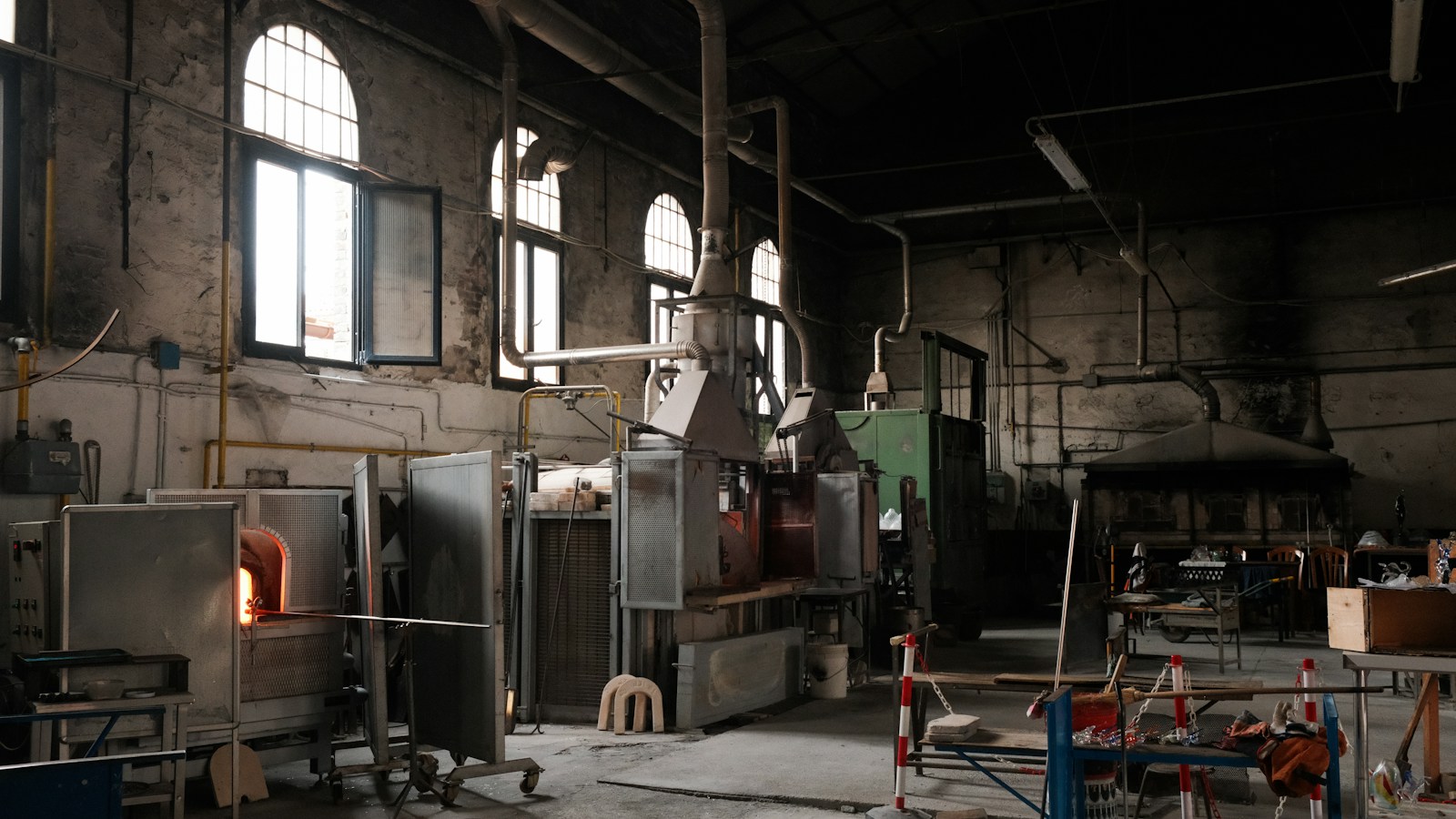
Illustrative Murano workshop photograph by Jaz Blakeston-Petch, https://unsplash.com/photos/a-large-room-with-a-bunch-of-machines-in-it-X9n0dW8kOAw. Not an exhibition view.
Another angle on this subject
Continue through related ideas, decisions and consequences.
 Culture & Ideas
The Morgan’s Ragtime Exhibition Puts the Printed Score Between Two Performances
A new exhibition and catalogue make room for a question that a silent page cannot answer alone: how does performed music travel?
 Culture & Ideas
A Documentary Exhibition Is an Invitation, Not a Complete National Record
A new Havana exhibition prompts a curatorial question: how can selected documents invite inquiry without pretending to contain the whole history?
 Culture & Ideas
A Photograph’s Credit Should Travel as Far as the Image
An upcoming Lucia Moholy exhibition offers a reason to examine whether authorship remains visible when an image moves between publications and displays.