
What a Master Canoe Builder Teaches Beyond the Finished Boat
UNESCO’s tribute to Sione Tu’i’one Pulotu raises a practical question for craft programmes. What can an apprentice judge after the master has stepped away?
Inside this article
01An obituary can direct attention to the workshop ↓02Watch the decision before the cut ↓03The next piece is part of the lesson ↓Event / source date: 10 November 2026 (UNESCO tribute) · Published 11 NOVEMBER 2026
An obituary can direct attention to the workshop
On 10 November, UNESCO published a tribute to Sione Tu’i’one Pulotu, the Tongan master carver and traditional canoe builder from Pangai, Ha’apai. The tribute credits him with building a sailing canoe for King Tāufaʻāhau Tupou IV and contributing to the Hawaiian voyaging canoe Iosepa. It also describes canoe-carving training with Tonga’s Ministry of Tourism and the tools he carved for ngatu making. These are accounts of past work and teaching. The tribute gives no date of death and offers no assessment of what individual trainees went on to do.
A finished canoe gives a visitor a way to appreciate the result. A teacher has to make a different part of the work visible. The learner needs opportunities to judge an unfinished piece while several outcomes are still possible. That question about what passes between two people in a workshop can guide the design of a training programme long after the exhibition has closed.
Watch the decision before the cut
Imagine a workshop demonstration in which a master notices an irregularity in a piece of wood and adjusts the next step. The students see a small pause, a change in position and a clean result. From the back of the room it looks as though the sequence simply went to plan. A student working alone with a different piece may remember each movement and miss the condition that made one of them appropriate.
This is an illustrative scene, separate from the documented work of Pulotu. Its point is that a demonstration can make the right decision look inevitable. An instructor might instead invite the learner to describe what they see, identify two possible next steps and explain when they would set the piece aside. The answer gives the instructor something more informative than the finished surface. It also leaves room for a student who notices a different relevant detail.
The next piece is part of the lesson
A group can assemble one impressive object through a sensible division of labour. The person who prepared a section may have understood that step thoroughly while having little opportunity to see how the next decision depended on it. A programme can honour a collective result and still be clear about what each learner practised.
A repeat exercise with a changed condition gives the teacher a way to see what carries over. In a hypothetical exercise, a learner who was assigned an identical blank the first time could be offered a different practice piece and asked to identify which parts of the old approach still apply. The exercise should remain within a safe scope chosen by practitioners. Asking for an explanation during practice is quite different from authorising someone to build or use a vessel independently.
Pay for the hours in which the answer changes
A programme budget can describe materials and the final demonstration with some precision. It should also make the cost of repeated feedback visible. That includes time when a teacher can stop an exercise, let a learner take a second look and return to the explanation later. A schedule committed to one public result on a single date gives those moments very little space.
A useful funding decision might reserve a workshop for successive visits, allow practice material to be used on unfinished trials and agree who can return after the public event. That arrangement has a different purpose from paying for an exhibition piece. The funder can ask whether learners were able to return, revise their work and explain changes. It can leave judgments about who is ready for more responsibility to the people qualified to make them.
Let practitioners decide what can travel
UNESCO’s 2003 convention places traditional craftsmanship among the domains of intangible cultural heritage. Its definition of safeguarding includes education and transmission alongside documentation and preservation. Those options leave an important decision with the people who carry the practice. A filmed demonstration and a supervised learning relationship have different audiences. A trainer who welcomes apprentices can still have sound reasons to limit recording or reuse of a particular explanation.
A cultural organisation can agree in advance which material may be filmed, who can see the recording and how later use will be discussed. An exhibition can give credit to the teachers and direct interested people to arrangements the community has chosen to make available. It can also respect the boundary between a public account of the work and the permission to reproduce it.
Ask what the next person can explain
A programme report could show three kinds of evidence side by side. A public display demonstrates what was produced. A supervised exercise shows what a learner could do under stated conditions. A later session reveals whether the learner can recognise a relevant change and explain their response. Those records serve different purposes, and each deserves a clear description.
The discussion about places where a language can be used raises a related issue of repeated access. Canoe craft adds the question of how a teacher makes their judgment available in a particular piece of work. In the wake of UNESCO’s tribute, an institution planning to honour a master’s contribution can ask who will have time with the next learner, what that learner will be able to attempt again and whose judgment will decide when the next step is appropriate.
Gabriel Nicolaev — CyGuru
Sources & further reading
UNESCO tribute to Sione Tu’i’one Pulotu ↗
UNESCO 2003 Convention, 2022 Basic Texts, Article 2 ↗
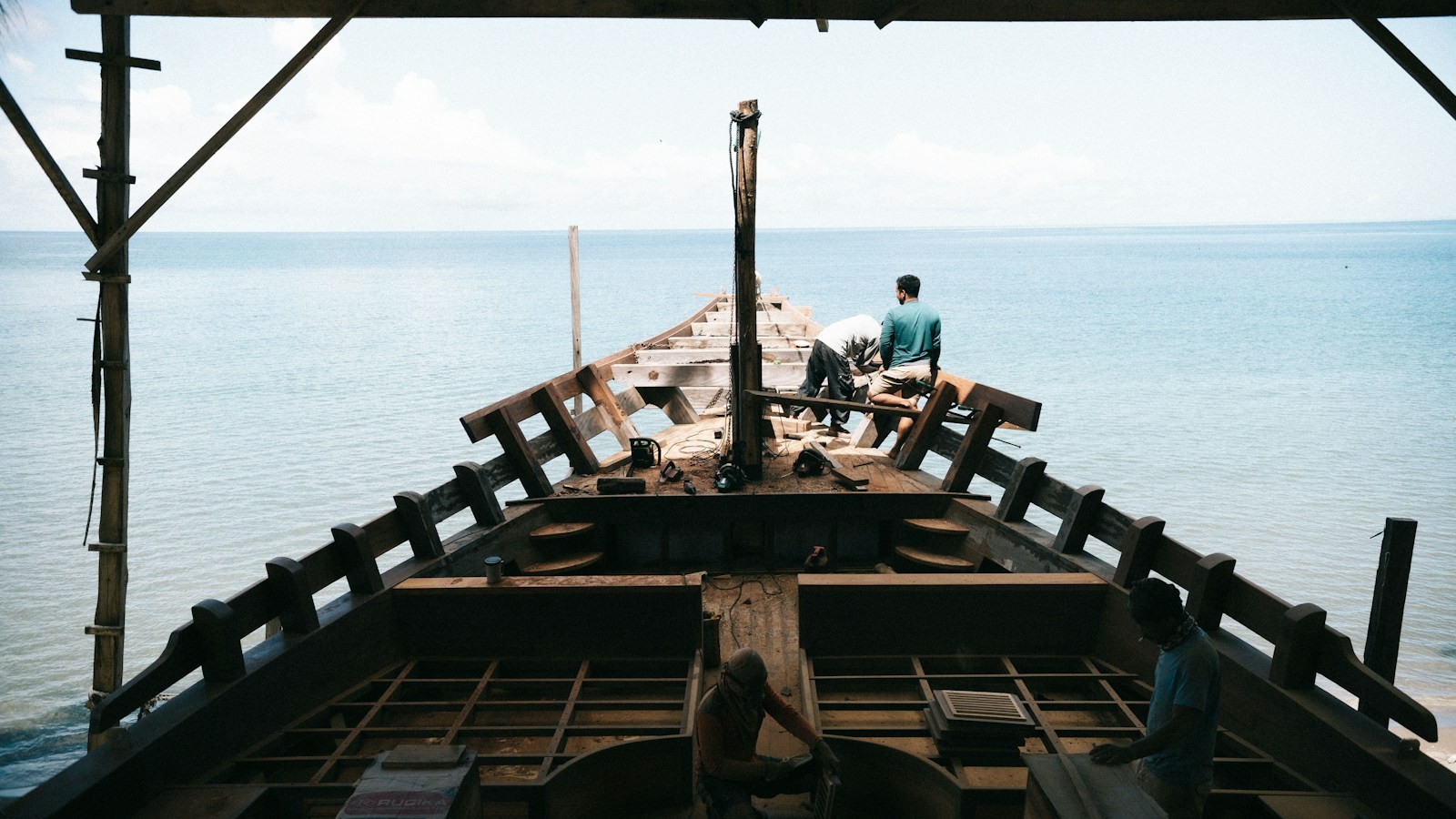
Exposed ribs and planks of a wooden boat under construction beside the sea. Illustrative photograph. Photo by Ichsan Chairul on Unsplash.
Another angle on this subject
Continue through related ideas, decisions and consequences.
 Culture & Ideas
A Digitised Archive Can Still Lose the Story Behind Its Images
After UNESCO’s audiovisual heritage observance, the preservation question extends beyond files to context, attribution and future access.
 Money & Business
Services Exporters Need a Margin Map, Not Just a Demand Forecast
The WTO’s split outlook for goods and services raises a practical question: which contracts still create value after travel, delivery and operating costs?
 Culture & Ideas
Philadelphia’s Sunday Best Raises a Question About What Clothes Can Tell Us
The Philadelphia Museum of Art has announced a 2027 show about Black diasporic style. The setting around each garment can change what visitors understand about it.