
The Western Sahara Veto Debate Puts the Costs of a Blocked Mandate on the Record
The General Assembly examined Russia’s veto on 10 November. Its debate allows more governments to explain their positions and gives the public a clearer record of the deadlock.
Inside this article
01A wider room to explain a narrower vote ↓02Count votes on the text that was actually put ↓03Separate the functions that travel in the same resolution ↓Event / source date: 10 November 2026 — General Assembly debate. 30 October — Security Council votes on the two draft resolutions. · Published 11 NOVEMBER 2026
A wider room to explain a narrower vote
The UN General Assembly debated the use of the Security Council veto on 10 November after Russia blocked a US-sponsored draft on Western Sahara on 30 October. Russia’s mission published its representative’s remarks on the day of the Assembly meeting. The draft concerned the mandate of the United Nations Mission for the Referendum in Western Sahara, known as MINURSO. The Council also considered a Russian alternative. It received three votes in favour, short of the number required for adoption, according to the chair’s announcement in the UN’s automated transcript.
Resolution 76/262 directs the Assembly president to convene a debate within ten working days after a veto, subject to an exception when the Assembly meets in emergency special session on the same situation. It also gives the vetoing permanent member priority in the speaking order. This procedure gives other governments a formal setting to challenge and explain the reasoning. The procedure itself leaves the blocked draft’s status as it stood after the vote.
Count votes on the text that was actually put
The Council chair announced eleven votes in favour of the US draft. That count describes support for a particular text. It bundles multiple choices. A government can want the mission’s field work to continue, accept a text as the best available compromise and still reserve its position on what a final settlement should contain.
The debate produced an example of that distinction. Hespress English reported Latvia’s explanation that its vote for the US text did not constitute recognition of Moroccan sovereignty. Latvia had already expressed that distinction in the 30 October discussion recorded by the UN transcript. The United States defended Morocco’s autonomy plan as a basis for negotiations, according to the account of the Assembly debate. Russia described the US draft as one-sided and said it had offered a one-year extension of the existing mandate. Those accounts show why eleven affirmative votes give a weaker basis for inferring agreement on a territorial outcome than they give for describing the draft’s support.
Separate the functions that travel in the same resolution
A resolution can combine the continuation of a mission, the political direction for negotiations and reporting requirements. Governments can disagree on one part while valuing another. The drafting problem is that a single vote usually forces them to take a position on the package as a whole.
A useful reading of the Western Sahara debate asks which operational functions each government wanted to preserve, for how long and under what authority. It also asks which language a delegation considered essential to the political process. Disagreement on those two questions can produce the same vote through very different reasoning. The alternative Russian text shows why a proposal described as a technical extension can still face political disagreement about what the extension would sustain or defer.
The alternative needs its own explanation
A vote against a bundled text becomes easier to assess when the objecting government identifies a workable change. Russia argued that its shorter proposal offered continuity. That proposal drew far fewer affirmative votes than the US draft. The public account should treat the second vote as a separate event with its own requirements. The Russian proposal lacked sufficient affirmative support even apart from the single vote against it.
Other governments could explain which functions they considered necessary, which political language they could accept and why they did or did not support an interim route. Such explanations would show whether there was a realistic path to agreement. A claim that the other side alone caused the loss of continuity should be tested against the actual alternatives and the conditions each delegation placed on them.
Scrutiny should follow the practical responsibility
Observers will need dated information about changes in the UN’s field functions and the arrangements for any continued diplomatic engagement. These are distinct questions. A political representative may still have work to do even if a field operation loses authority for a specific task. Similarly, the presence of personnel during a transition gives limited information about the monitoring or reporting they are authorised to perform.
Our earlier piece on ceasefire incident reporting asks what an observation can prove once it reaches a public record. Here the threshold question is whether any institution has the authority and practical capacity to collect such observations over time. What happens to the ability to compare accounts when a reporting channel is interrupted? That is an operational consequence to examine with direct evidence as it becomes available.
A useful public record makes the next proposal testable
The Assembly meeting puts explanations into public view and creates a basis for asking more precise questions when new language appears. Would a later proposal restore a particular function? Which governments are prepared to support that provision? What unresolved disagreement would it leave to negotiations? Each question can be answered through a document, a vote or a verified operating arrangement.
Public debate can clarify the choices that produced deadlock. Its value after 10 November will depend in part on whether readers can connect statements to those choices. The fuller record gives them a way to examine what governments say they wanted, what they actually voted for and what responsibilities they are prepared to assume next.
Gabriel Nicolaev — CyGuru
Sources & further reading
Russian Permanent Mission to the UN — 10 November General Assembly statement ↗
UN Transcripts — 30 October Security Council debate on Western Sahara ↗
UN General Assembly Resolution 76/262 — Veto debate mandate ↗
Hespress English — Positions presented at the General Assembly debate ↗
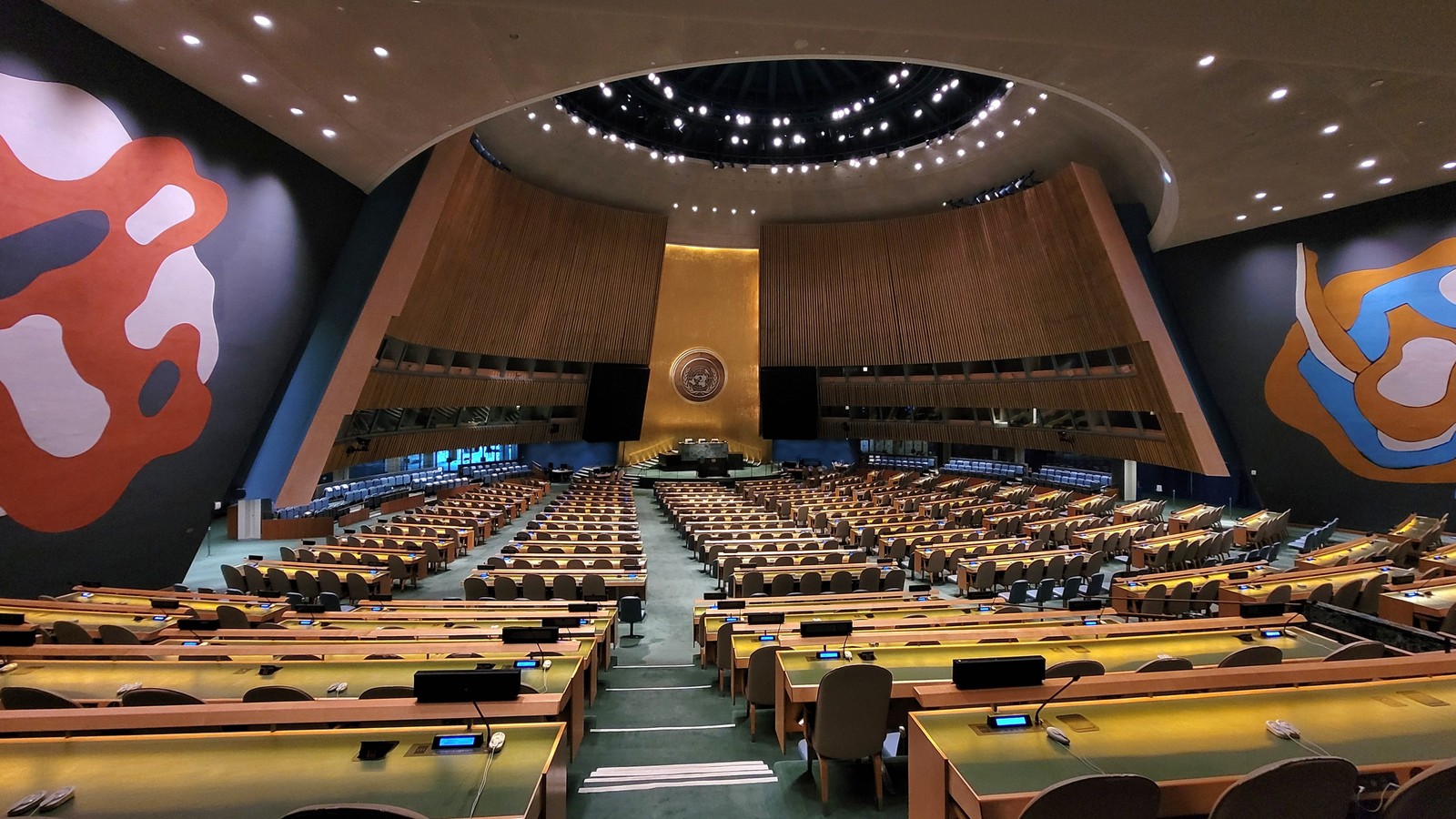
Archive photograph of the UN General Assembly Hall, February 2024. Mojnsen, Wikimedia Commons. CC BY-SA 4.0 (https://creativecommons.org/licenses/by-sa/4.0/). Source https://commons.wikimedia.org/wiki/File:United_Nations_General_Assembly_2024.jpg. Resized and cropped for this edition. The local derivative is distributed under CC BY-SA 4.0.
Another angle on this subject
Continue through related ideas, decisions and consequences.
 World & Power
Europe’s Ukraine Negotiating Team Needs More Than a Shared Seat
The Dublin meeting identified a European negotiating team. Its effectiveness will depend on matching diplomatic positions to the institutions that can deliver them.
 World & Power
Spain’s Housing Strike Put Workplace Leverage Behind a Public Demand
Spain’s 11 November general strike joined tenant and labour demands. Turning that coalition’s pressure into results means identifying which institutions can act on each request.
 World & Power
A Public Pilot Needs a Way to End Its Exemptions
An experimental public service can test a new approach while leaving temporary exceptions behind. Its design should explain what happens when the test ends.