
The Building Is Part of the Haeinsa Collection
A UNESCO series has brought Korea’s Tripitaka woodblocks back into view. Their purpose-built depositories show what changes when conservation treats a building as part of the collection.
Inside this article
01The collection includes the space between objects ↓02Treat a repair as an environmental change ↓03Shelving has a conservation history too ↓Event / source date: 7 November 2026 (series launch) and 10 November 2026 (UNESCO account) · Published 11 NOVEMBER 2026
The collection includes the space between objects
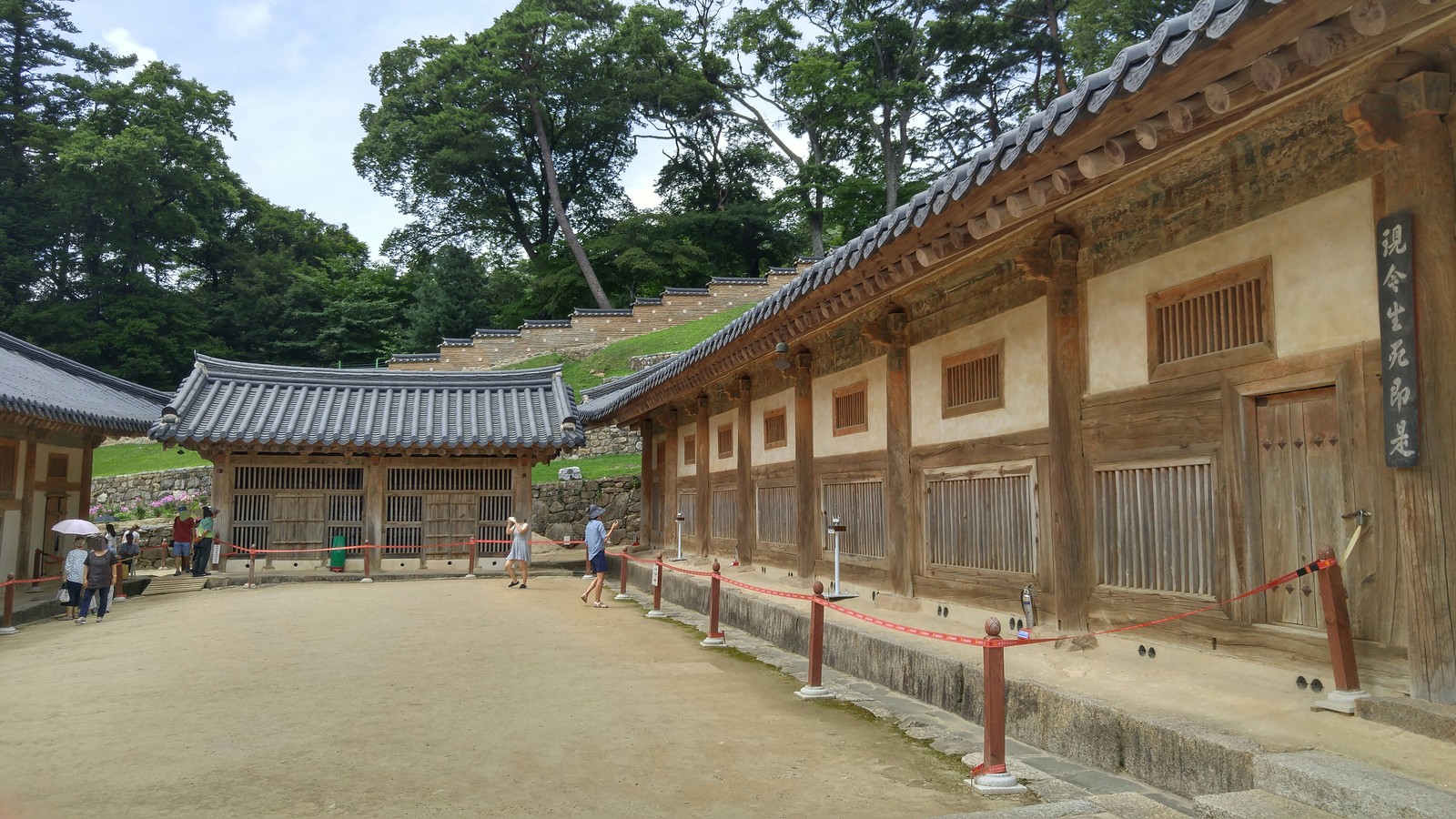
The fourth season of UNESCO’s World Heritage Series launched with a trailer on 7 November. Its 10 November account of the Korea season presents the depositories at Haeinsa among six featured World Heritage properties. The World Heritage Centre’s record describes about 80,000 Tripitaka Koreana woodblocks engraved between 1237 and 1248. The depositories built to house them date to the fifteenth century and stand around a courtyard. Their design provides natural ventilation and helps regulate the conditions in which the blocks are held.
The season is new. The conservation system it brings into view is longstanding. At Haeinsa, an account of the woodblocks that ends at the surface of a carved character leaves out much of the reason they can still be studied. The storage building and the arrangement inside it form part of the objects’ physical history. Their preservation calls for attention to relationships that can disappear in a photograph of either the blocks or the architecture.
Treat a repair as an environmental change
Imagine a historic storehouse with an opening that a modern builder could close to keep out driving rain. Look at the repair from outside and the choice may appear straightforward. Look at the room from the shelf and there are further questions. What did that opening contribute to air movement? How was water managed before the proposed change? Would another part of the room experience different conditions? These are questions for a conservation team in a hypothetical case, separate from any repair at Haeinsa.
The World Heritage Centre notes that the depositories were adapted to local conditions and calls for continuing temperature and humidity monitoring. That creates a test for decisions about the fabric. A proposed intervention should have an account of which environmental function it could affect and what observations would make the team revisit the decision. A photograph of newly repaired timber cannot answer those questions.
Shelving has a conservation history too
A shelf can look like replaceable furniture when the object on it receives all the attention. It may also determine how a piece is supported, what is exposed to moving air and how easily someone can reach it for an examination. The World Heritage Centre’s account notes the continuing need for repairs to both the woodblocks and the shelves. It also identifies the susceptibility of the wooden blocks and buildings to fire damage.
Those observations invite a detailed inventory that tracks the places where object and environment meet. In a hypothetical store, it could record how a support is arranged, what access a conservator needs and which parts can be replaced independently. If a treatment requires temporary movement, staff can document the conditions at the destination and the sequence for returning each piece. The unit of care extends across shelf, block and room, even when budgets assign them to different teams.
Agree on what monitoring is for
A room reading can be useful while saying little about what a particular object experienced. Imagine a team deciding to check a sensor after a roof repair. It could first ask which shelf, exposure or interval matters to the proposed intervention. That question shapes where the sensor should sit and how long the team needs to observe before interpreting a change. It also helps distinguish a measurement issue from a genuine change in the room.
The point of recording conditions is to support a decision. If an observation raises concern, someone has to know who can inspect the area, compare it with an earlier period and discuss whether further work should pause. The site record describes responsibilities shared among the temple and public bodies. A conservation account becomes more informative when a reader can see how observations about the building reach the people who can act on them.
Plan interpretation around the conditions of care
UNESCO’s World Heritage record describes restrictions on entry to the depositories connected with management of internal conditions. Readers looking for a visit should consult current site information for practical arrangements. A video can offer something valuable even where physical entry is limited. It can show how the structures relate to one another, explain what the blocks were made to do and identify the care behind their survival. It can communicate the reasons for a limit without implying that the full premises are open.
The question resembles the one raised by a heritage visitor limit, where the relevant constraint can be found at a particular point in a route. Here the sensitive relation is between a room and its collection. A presentation that explains the relation can give the visitor a way to understand why a conservation decision applies to a space that looks ordinary from outside.
Give the building a role in the catalogue
A publication about Haeinsa could invite readers to follow two records. One concerns the texts and the blocks on which they were carved. The other concerns the depositories, their use and the maintenance that allows them to continue housing the blocks. Connecting those records would show why a decision about storage can matter as much as a decision about display.
There is a practical implication for institutions that manage collections in historic spaces. Before approving a repair, ask what the room contributes today and which objects depend on that function. Document the answer in the collection record and attach it to the work plan. Haeinsa’s place in the new series gives audiences a chance to see a collection whose survival is inseparable from the architecture built around it.
Gabriel Nicolaev — CyGuru
Sources & further reading
UNESCO World Heritage Series, Korea season ↗
World Heritage Centre property record for Haeinsa ↗
Archive photograph of the Janggyeong Panjeon complex at Haeinsa, August 2017. SpongeFan0304, Wikimedia Commons. CC BY-SA 4.0 (https://creativecommons.org/licenses/by-sa/4.0/). Source https://commons.wikimedia.org/wiki/File%3A20170812.%ED%95%B4%EC%9D%B8%EC%82%AC_%EC%9E%A5%EA%B2%BD%ED%8C%90%EC%A0%84%28Haeinsa_Janggyeong_Panjeon%29.02.jpg. Resized and cropped for this edition. The local derivative is distributed under CC BY-SA 4.0.
Another angle on this subject
Continue through related ideas, decisions and consequences.
 Money & Business
Inventory Becomes a Liability When Nobody Owns the Exit
A stock purchase needs a route back into cash, including who acts when demand changes and the original selling plan no longer holds.
 Culture & Ideas
Along Animal Trails Asks How Museums Can Show a Shared History
UNESCO has announced the digital launch of an exhibition made by ten museums. A vessel recovered off Brunei illustrates how curators can explain what travelled and what remains uncertain.
 The CyGuru Column
The authority to wait
Waiting becomes a form of authority when it has a purpose, a deadline and a condition for action. Without those boundaries, patience can become a persuasive explanation for avoidance.