
The Money Code: Six Languages, One Question About Financial Freedom
Gabriel Nicolaev — CyGuru introduces The Money Code across six language editions, asking what earning, ownership and obligations actually make possible.
Inside this essay
01Six languages, one invitation to examine the arrangement ↓02Start with what a payment changes ↓03Do not confuse a personal pattern with the whole explanation ↓Six languages, one invitation to examine the arrangement
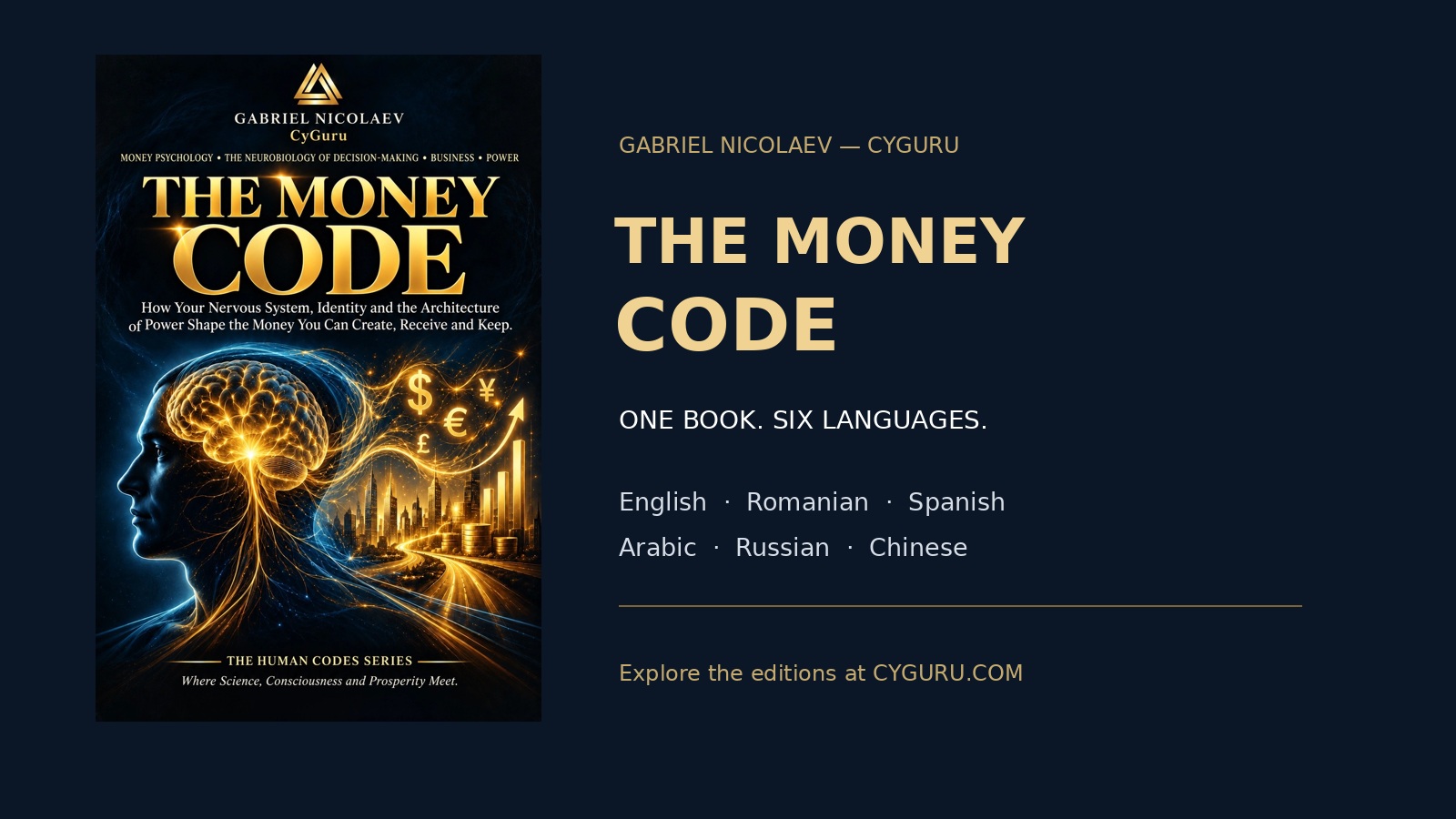
The Money Code is now presented on CYGURU.COM with six language editions: English, Romanian, Spanish, Arabic, Russian and Chinese. For me, the significance is more than a longer list of markets. It is the opportunity to put a demanding conversation about money into the language in which a reader can question it most precisely.
The book’s English edition is described as forty chapters, with diagnostic questions, practical exercises and structured protocols. Its stated themes include financial behaviour, identity, value creation, pricing, negotiation, ownership and obligations. These are the author’s framework and publishing description, not independently established evidence that reading the book will produce a particular financial outcome. The argument of this essay is that a money book earns its place when it improves the questions a reader brings back to actual decisions.
Start with what a payment changes
Imagine a hypothetical professional who receives a larger payment and immediately commits it to a more demanding arrangement: a larger fixed expense, another promise or work that leaves less room for independent choice. The payment may be welcome. The useful question is what has changed after the commitments attached to it have been recognised.
That question is not an argument against earning more. It asks for a fuller account of progress. Which obligation has become easier to meet? Which dependency has been reduced? What choice can now be made without waiting for the next receipt? A financial result becomes more meaningful when it can be connected to an actual change in the person’s options. The number matters, but it should not be asked to tell the whole story by itself.
Do not confuse a personal pattern with the whole explanation
A reader can examine avoidance, the desire for recognition or discomfort in negotiation without pretending that every financial constraint began inside the individual. Prices, contractual terms, responsibilities and access to opportunity also belong in the account. Blaming everything on mindset would make the analysis less exact, not more powerful.
A hypothetical person might postpone an important money conversation because it feels difficult. The conversation might also concern an arrangement in which the other party has substantially more choice. Those are different parts of the same decision. Naming the hesitation does not erase the imbalance; naming the imbalance does not decide whether another response is possible. A useful reflection should make both visible and ask what can actually be changed, by whom and at what cost.
A framework should return you to a concrete decision
The practical test of an idea is not how forcefully it can be repeated. It is whether the reader can use it to examine something that previously remained vague. Choose one decision: accepting an engagement, changing an expense, negotiating a price or allocating a receipt. Then identify the commitment, the alternatives and the information still missing.
For a hypothetical independent worker, accepting a project could mean money, learning and a responsibility that occupies a particular period. Rejecting it could preserve time while leaving another need unresolved. The relevant task is to describe the whole exchange accurately. An exercise should help the reader see that exchange, rather than supply a flattering label for the answer they already wanted. A decision made with clearer assumptions remains a decision whose consequences must be carried.
Why language belongs inside the financial conversation
Financial words carry practical distinctions. A reader needs to understand whether a statement concerns income, an obligation, ownership, the price of work or the resources still available after commitments. Reading in a familiar language can make it easier to examine the intended distinction; it does not remove the need to check how a term applies in a real agreement.
Six language editions therefore expand the routes into the conversation without implying six identical financial environments. A reader in one country should not assume that a general reflection settles the tax, employment or contractual treatment in another. Nor should a translation be treated as proof that every example fits every household. The worthwhile ambition is an intelligible discussion that travels while leaving readers responsible for their own circumstances, evidence and local requirements.
Choose your edition through the book’s verified language links
The product page provides separate Apple Books links for the English edition, Romanian edition, Spanish edition, Arabic edition, Russian edition and Chinese edition. These links let readers reach the relevant listing instead of guessing from a cover or a similar title. The retailer’s page remains the place to confirm the current edition details, pricing and availability before purchasing.
At the time this feature was checked, the product page marked the Amazon language options as coming soon. That distinction matters: a planned purchasing route should not be presented as an active link. The central CYGURU.COM book page provides a practical reference for the editions and the author’s description. Choose the language in which you can read attentively, and inspect the listing rather than treating the presence of a link as a guarantee about every store or territory.
Read with a question you can bring back to your life
Before opening the book, write one question you would like to examine more honestly. It could concern the work you accept, the terms you avoid discussing or the difference between an expense you value and an expense you maintain for appearance. The question should be specific enough that a chapter can challenge an assumption rather than merely confirm an identity.
After reading, record what changed in your understanding and what has not yet been tested. You do not need to announce a complete reinvention. You need to identify whether a more precise conversation, a revised commitment or further information is now required. That is the invitation behind this six-language feature: meet the ideas in a language you can use fully, question them seriously and return to your decisions with greater clarity. Financial freedom deserves an account of the choices it actually makes possible.
Gabriel Nicolaev — CyGuru
Sources & further reading
The Money Code — official book and six-language edition page ↗
Editorial book graphic using the author’s verified English cover; language names identify the six editions linked on CYGURU.COM.
Another angle on this subject
Continue through related ideas, decisions and consequences.
 The CyGuru Column
Loyalty Does Not Require You to Certify What You Never Saw
A CyGuru essay on supporting someone you care about while keeping a clear boundary between what they told you, what you believe and what you actually witnessed.
 The CyGuru Column
You Can Move Forward Without Winning the Final Argument
A CyGuru essay on ending your participation in an unresolved argument while remaining precise about obligations, evidence and the account you are willing to own.
 The CyGuru Column
Gabriel Nicolaev — CyGuru: A UAE Book Presentation and the Projects Behind My Work
A personal presentation of UAE — The Opportunity Economy to Mr. Moustafa opens a wider account of my books, Human Codes and publishing projects.