
Motor Learning Looks Different After Thousands of Reaches
An extended reaching experiment separates end-of-session performance from retention and transfer. It offers a better way to frame what practice has achieved.
Inside this article
01A successful reach can hide a choice of measurement ↓02Distinguish position from prediction ↓03Test what survives the interval ↓Event / source date: 9 November 2026 · Nature Human Behaviour publication listing. The experimental details below come from the 24 February 2025 author preprint. · Published 11 NOVEMBER 2026
A successful reach can hide a choice of measurement
Watching someone repeat a movement tells you how that movement looks in the setting where it is performed. To study what they have learned, it helps to ask what happens after a break, after the equipment changes or when they try a nearby movement. Each test asks for a different expression of the skill. An extended laboratory experiment by David Franklin and colleagues makes those questions unusually concrete.
Nature’s research index lists the journal article on 9 November. The experimental details in this analysis come from the accessible author preprint posted in February 2025. Ten adults used a robotic handle for reaching movements across eight weeks. The device could apply a force that deflected a reach, and participants practiced mainly in one direction. The team recorded thousands of attempts and scheduled a further session 15 weeks after the training period. The setting allows a precise look at adaptation to one disturbance. A curriculum for a sport, craft or clinical population would require separate evidence.
Distinguish position from prediction
A straight hand path looks like evidence of improvement. A researcher can also ask whether the participant anticipates the force or corrects the movement after it begins. The study included constrained trials in which the apparatus held the handle close to a straight path. Forces against that constraint gave the researchers a way to estimate the participant's prepared compensation.
That distinction makes the task more interesting than a count of hits and misses. Imagine an apprentice learning to operate a hypothetical handle that pulls sideways as it moves. One attempt reaches the target after a late correction. Another goes directly there because the apprentice applies a suitable opposing force during the reach. Both finish successfully. A supervisor interested in the reliability of the movement would want some evidence about the route as well as the endpoint.
Test what survives the interval
In the preprint, compensation improved quickly within the first session and continued to increase with training. The authors also examined the forces people produced at the beginning of later sessions. That comparison concerned what they could express before making a new series of ordinary attempts, rather than what they could restore by the end of the session. The authors report retention over the long follow-up interval in this particular task.
An instructor designing a hypothetical evaluation could follow the logic without imitating the experiment. Record the end of today's practice. At the next session, observe the first few attempts under the same conditions before offering reminders. Then record the result after warm-up. A difference between those observations provides information about immediate recall and the work required to get back to the previous level. A single end-of-session score would combine them.
Ask how far the trained action travels
Practice in the experiment concentrated on one reaching direction. The researchers also used nearby angles to study how a learned compensation generalized, and the preprint reports that the pattern became more concentrated around the trained direction. The experiment explored transfer to the other arm as well. Performance in a practiced condition and adaptation in a different condition are separate objects of measurement.
That point matters when a practice goal includes changed conditions. Suppose a fictional apprentice produces accurate work with a fixture always placed in the same position. The training goal might be a stable result in that workstation. If the job also requires accuracy when the fixture moves, the assessor should build in a test of the changed position. It would be a mistake to use the number of successful repetitions at the original workstation as the only evidence for the expanded role.
Explain the limits of a long experiment
Thousands of attempts provide many observations of change within the same people. They do not turn ten participants into thousands of separate participants. Nor does the apparatus establish how a person learns a whole activity, where perception, rules and several movements may change together. The experiment is instructive because it keeps the task narrow enough to observe distinctions that a broad score could hide.
A reader can therefore apply the questions without carrying over the answer. How was learning measured? Was there a delay before the test? How different was the later condition? Were the same people observed? Our earlier examination of the conditions for comparing learning asks a related question about education data. In movement research the answer turns on whether the conditions elicit the original adaptation, a newly prepared action or an ability to work in a changed context.
Give practice a more precise purpose
Someone choosing what a practice session is for may want enjoyment, immediate control, recall after a pause or a broader range of movements. The assessment can match that purpose. A repeated demonstration in familiar conditions is suitable evidence for one of those goals. A delayed attempt or a variation of the task helps investigate another.
The experiment gives a concrete reason to keep those measures apart. Its trained reach became more precise, its retention changed over weeks and the pattern across directions changed too. For a teacher or learner, the next step is to state which outcome matters and design a way to observe it. That makes practice easier to evaluate and preserves what a successful repetition has actually shown.
Gabriel Nicolaev — CyGuru
Sources & further reading
Nature research index · publication record ↗
Franklin and colleagues, author preprint on long-term motor memory ↗
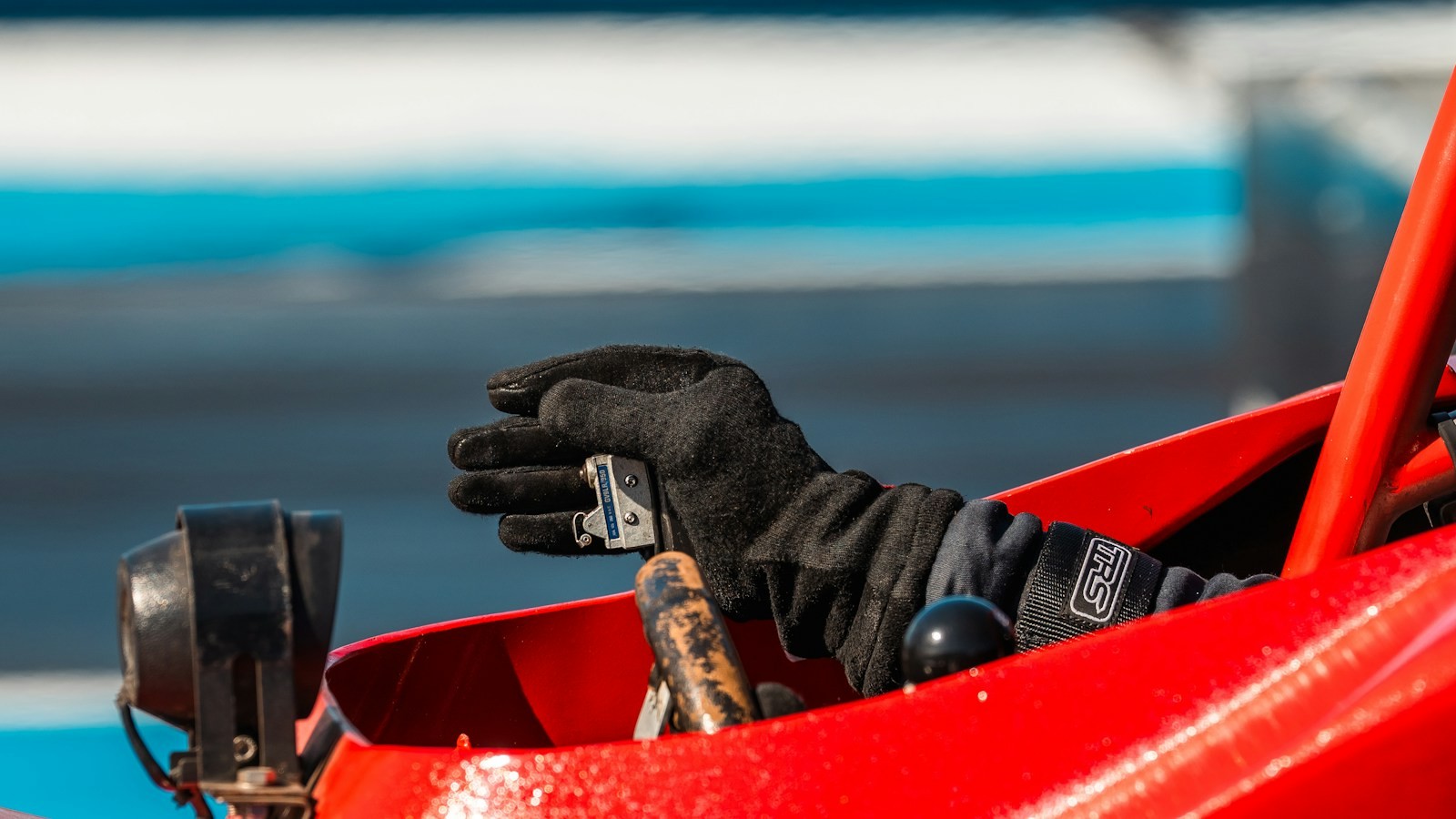
A gloved hand poised over a lever in a red racing cockpit. Illustrative photograph. Photo by Jack Stapleton on Unsplash.
Another angle on this subject
Continue through related ideas, decisions and consequences.
 Human Behaviour
You Do Not Need to Be Good at Something to Enjoy Learning It
Beginner practice can be worthwhile before it looks impressive. Separate pleasure, improvement and public performance without making competence the price of entry.
 Technology & AI
AlphaGenome 2 Puts the Cell State Inside the Genetic Prediction
DeepMind’s new model asks how the same DNA change behaves across different kinds of cells. Its output is a way to choose a better experiment.
 Human Behaviour
When Multitasking Looks Fast, Count the Missed Answers
A new experiment separates response speed from success across competing visual and auditory tasks. That distinction changes how a busy workflow should be evaluated.