
AlphaGenome 2 Puts the Cell State Inside the Genetic Prediction
DeepMind’s new model asks how the same DNA change behaves across different kinds of cells. Its output is a way to choose a better experiment.
Inside this article
01A DNA change needs a biological address ↓02What changed in the model ↓03Read the benchmark as a comparison ↓Event / source date: 11 November 2026 — Google DeepMind announced AlphaGenome 2 and described access for researchers. · Published 13 NOVEMBER 2026
A DNA change needs a biological address
A scientist following a genetic association can end up with several nearby DNA changes and one difficult decision about what to test first. The choice includes both the letter that changed and the cells in which the change might matter. A region that looks quiet in a broad tissue measurement can still contain a regulatory effect limited to a particular population of cells or a temporary state.
On 11 November, Google DeepMind announced AlphaGenome 2, a model that predicts molecular effects using both a long stretch of DNA and a biological condition. The condition can be a type of cell, a tissue, or a state inferred from measurements in a single-cell experiment. DeepMind says researchers can access the model for non-commercial work through its API, with commercial research in private preview. The announcement says the system is intended for research, with clinical and diagnostic uses outside its validation.
The useful question for a research team is how a result changes the design of its next experiment. A model that suggests a particular condition can narrow the first assay. The certainty that comes from a well-controlled experiment still depends on what is actually measured.
What changed in the model
The earlier AlphaGenome architecture returned many predetermined outputs at once from about one million DNA letters. In the redesign, a target condition is supplied together with the sequence. According to DeepMind, the model uses that condition throughout the computation and predicts molecular activity for it. The company reports training on more than 107 million individual cell profiles along with data from bulk tissue samples, drawing on human and mouse material.
This makes the input question more explicit. A researcher can ask about the same sequence in two different biological settings and compare the resulting predictions. One result may concern gene expression, which describes the activity of a gene in the conditions sampled. Another can concern chromatin accessibility, which concerns how exposed a region of packaged DNA is to molecular machinery. Those are different measurements. If an assay reports one and the model estimates the other, the two records should retain their separate provenance.
DeepMind also says the model can infer a representation of a previously unseen state from a new single-cell gene-expression experiment without retraining. In a lab, that could make it easier to ask a question about a condition missing from a reference catalogue. Whether the supplied cells represent the precise condition of interest remains a property of the experiment and its sampling.
Read the benchmark as a comparison
On a single-cell immune dataset called TenK10K, DeepMind reports identifying 30 percent of causal variants under its evaluation, compared with 16 percent for the earlier approach it describes. It reports 43 percent versus 23 percent for identifying the direction of a gene effect. The measurements concern particular data, baselines and evaluation definitions. The two percentages answer different questions and cannot be combined into a single accuracy rate.
A laboratory choosing a project should ask whether its cell populations and candidate variants resemble the cases used for the comparison. A short list for an immune-cell study may be more relevant to this test than a ranking for an unfamiliar cell state. The benchmark also leaves substantial room for real candidates to fall outside the model's identified set. A lower score can guide how work is sequenced while leaving room for independent evidence that pushes a candidate higher.
CYPAPER’s article on designing AI evaluation sets explains why teams learn more by naming which examples a test leaves out. Here that means keeping the model's test cells, readouts and scoring criteria visible when a benchmark figure enters a proposal.
Give the prediction an experiment to lose
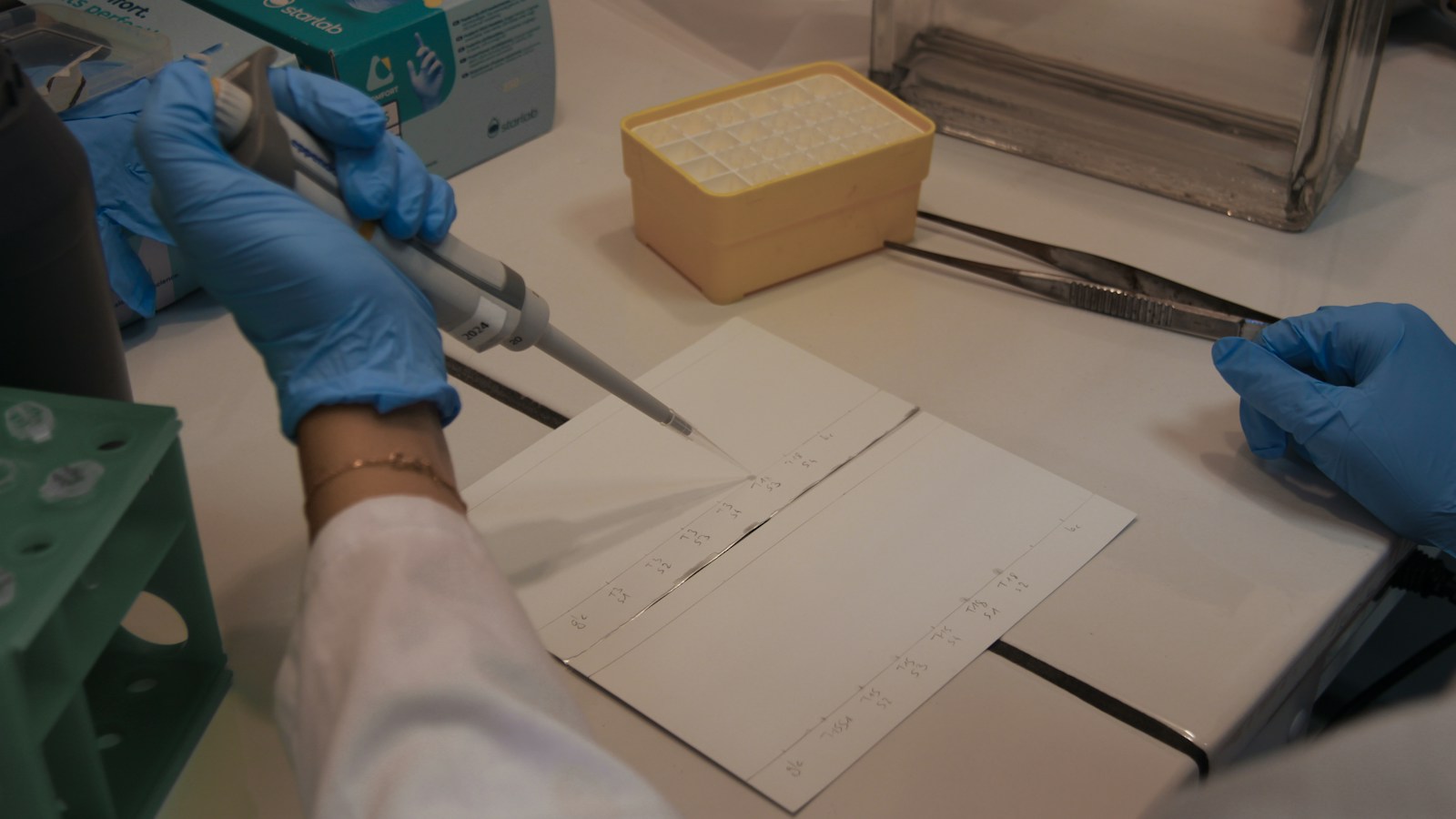
Imagine a team studying a noncoding variant near two plausible genes. It compares predictions for a resting immune cell and one stimulated under specified laboratory conditions. Suppose the model suggests that one gene's expression rises only in the stimulated state. The first decision is whether the lab can reproduce that state consistently enough to make the comparison meaningful. The next is how to change the candidate sequence while preserving a suitable comparison.
A good experiment would establish in advance the gene, the direction of change, the readout and the time of measurement. One group could carry the reference sequence and another the candidate alteration. Additional replicates could test whether the observation survives differences between preparations. An unexpected change in the second gene would matter. So would a result that appears under both conditions. Each outcome would update the proposed mechanism in a different way.
If a group has money for only a small number of experiments, it can preserve a place for a candidate chosen from a different line of evidence. That design provides an opportunity to detect whether the model is narrowing the list usefully or repeatedly directing attention toward conditions it predicts well.
Keep a usable record of the next result
A research group that uses the API can record the model version, input sequence, condition, predicted readout and direction before running an assay. It can also retain the selection rule that put a candidate above its neighbours. When the measurement arrives, those details make it possible to distinguish a wrong direction from a wrong condition, a mismatched assay or an ambiguous result.
The announcement matters because it gives scientists a more specific hypothesis to work with. A candidate can be described as a particular sequence change, in a specified condition, expected to move a particular readout. That is a tractable starting point. The value of the prediction grows when another person can repeat the comparison and see exactly which part of that claim survived.
Gabriel Nicolaev — CyGuru
Sources & further reading
Google DeepMind’s AlphaGenome 2 announcement ↗
Illustrative photograph by Nathan Rimoux, Unsplash.
Another angle on this subject
Continue through related ideas, decisions and consequences.
 Technology & AI
TerraNova’s Carbon-Removal Model Still Needs the Soil Sample
Microsoft and Terradot describe an AI approach to enhanced rock weathering. Its promise is better sampling design, not replacing field evidence with a prediction.
 Human Behaviour
Motor Learning Looks Different After Thousands of Reaches
An extended reaching experiment separates end-of-session performance from retention and transfer. It offers a better way to frame what practice has achieved.
 Technology & AI
A Confidential AI System Still Needs a Defined Trust Boundary
Google’s new TPU 8tx announcement raises a practical procurement question: which part of an AI workflow is protected, and who can still act on its output?