
What Nvidia’s Robot Benchmark Leaves for the Factory to Prove
The GR00T 2 results show how quickly a robot can learn a new task. Factory trials must account for the failures that still reach the next station.
Inside this article
01Two denominators tell two stories ↓02Five demonstrations buy a useful starting point ↓03The dangerous failure can look like a success ↓Event / source date: 9 November 2026 — Nvidia robotics research announcement · Published 12 NOVEMBER 2026
Two denominators tell two stories
Nvidia’s November 9 robotics announcement put a number on how quickly a general-purpose model can adapt to a new task on a particular machine. Its researchers tested GR00T 2 across 50 tasks on a bimanual robot equipped with Sharpa hands. Before any demonstrations on that robot, the model succeeded in an average of 40 percent of trials. It completed 40 of the 50 tasks at least once. For a factory operator, the first figure is closer to the question of how often work gets done. The second tells the operator where there may be enough capability to justify a closer look.
The phrase “new task” has a specific boundary here. Nvidia says the target robot had never been shown these tasks. Nvidia says the tasks appeared in human video or data from other robots. Transferring from those sources to a new embodiment is precisely the capability the research is trying to measure. A site that buys a machine to handle a special component still needs to establish whether what the model has seen elsewhere carries over to its part, tooling, fixtures and finish tolerances.
Five demonstrations buy a useful starting point
Nvidia reports average success of 71 percent after one demonstration and 95 percent after five. With five, 37 of the 50 tasks succeeded in every sampled trial. That last result helps describe the distribution. Some tasks still failed at least once. A buyer should ask how closely those difficult tasks resemble the operations on the proposed line. A high average can conceal an expensive problem concentrated in one product variant.
The researchers report about 30 minutes of adaptation on an RTX 5090 and under three minutes of demonstrations per task for the benchmark. Both figures are useful when estimating how much effort it takes to try a task. Installation also involves defining what a completed operation looks like, capturing the bad cases, integrating sensors and production records, and setting up a supervised response to uncertain states. Some of that work recurs when the line changes suppliers or switches to a new component revision. Keep separate estimates for teaching a motion, qualifying the operation and maintaining the station.
The dangerous failure can look like a success
Imagine a robot pressing a connector into a housing. The part can appear seated while a locking tab remains half engaged. A visible miss may stop the station at once. A false acceptance can send a defect downstream and leave the team tracing a batch after final inspection or a customer return. The site should record those outcomes separately. A robot that gets credit for reaching the end of its motion has passed a different test from a station that can prove the latch is engaged.
That distinction changes how a pilot is designed. A line engineer might introduce several connector lots, slightly misaligned housings and worn fixtures within approved test limits. An independent gauge or electrical test can define ground truth. Record where the model succeeded cleanly, recovered without damage, requested intervention, or let a bad part through. In an interrupted cycle, check whether a technician can identify the last confirmed state and safely resume or quarantine the assembly. A good pilot preserves footage and inspection results for the failures. CYPAPER’s coverage of AI evaluation sets makes a related point about including the cases a demonstration typically leaves out.
Count the cost of recovering the line
The research team also reports results from three toy assembly tasks designed to involve planning and recovery. It recorded 98, 97 and 97 successful runs out of 100 for the three tasks respectively. That gives the project a more specific recovery demonstration than the aggregate transfer score alone. The results describe those assemblies, under the researchers’ conditions. Production recovery adds questions about whether a part can be reused, whether the work queue can wait, and which hazards a retry may introduce.
Suppose a trial station produces 200 parts over a shift and calls an operator four times. Four calls sound manageable until each pulls a technician from a neighboring line, where another station is also waiting. Count minutes until service resumes, scrapped work, operator travel and who can cover the task on a night shift. Those costs depend on the workflow, so report them alongside the robot’s event logs. A recovery that works in five seconds and leaves a verified good part is materially different from a recovery that spends a minute repeating the same uncertain motion.
Qualify one operation before expanding the pilot
A sensible first deployment candidate has inspectable output and a defined way to hold suspect work. Run the candidate through normal variation, changeovers and supervised fault recovery. Compare it with the current process on accepted units, defects reaching the next station, total intervention time and equipment availability. Collect enough observations to see how common faults behave and use deliberately seeded challenges for rarer fault types. Keep the two sets of results separate so a test enriched with faults cannot be mistaken for a forecast of daily downtime.
GR00T 2 makes faster adaptation a plausible reason to try more operations. The factory still has to choose which operations can absorb an occasional miss, which need independent confirmation, and which deserve a fully staffed fallback. That decision belongs in the trial plan before the first demonstration is filmed. The closer the test follows a part from loading through acceptance or quarantine, the more the benchmark can inform a real purchase.
Gabriel Nicolaev — CyGuru
Sources & further reading
Nvidia robotics research announcement ↗
Nvidia GEAR GR00T 2 research results ↗
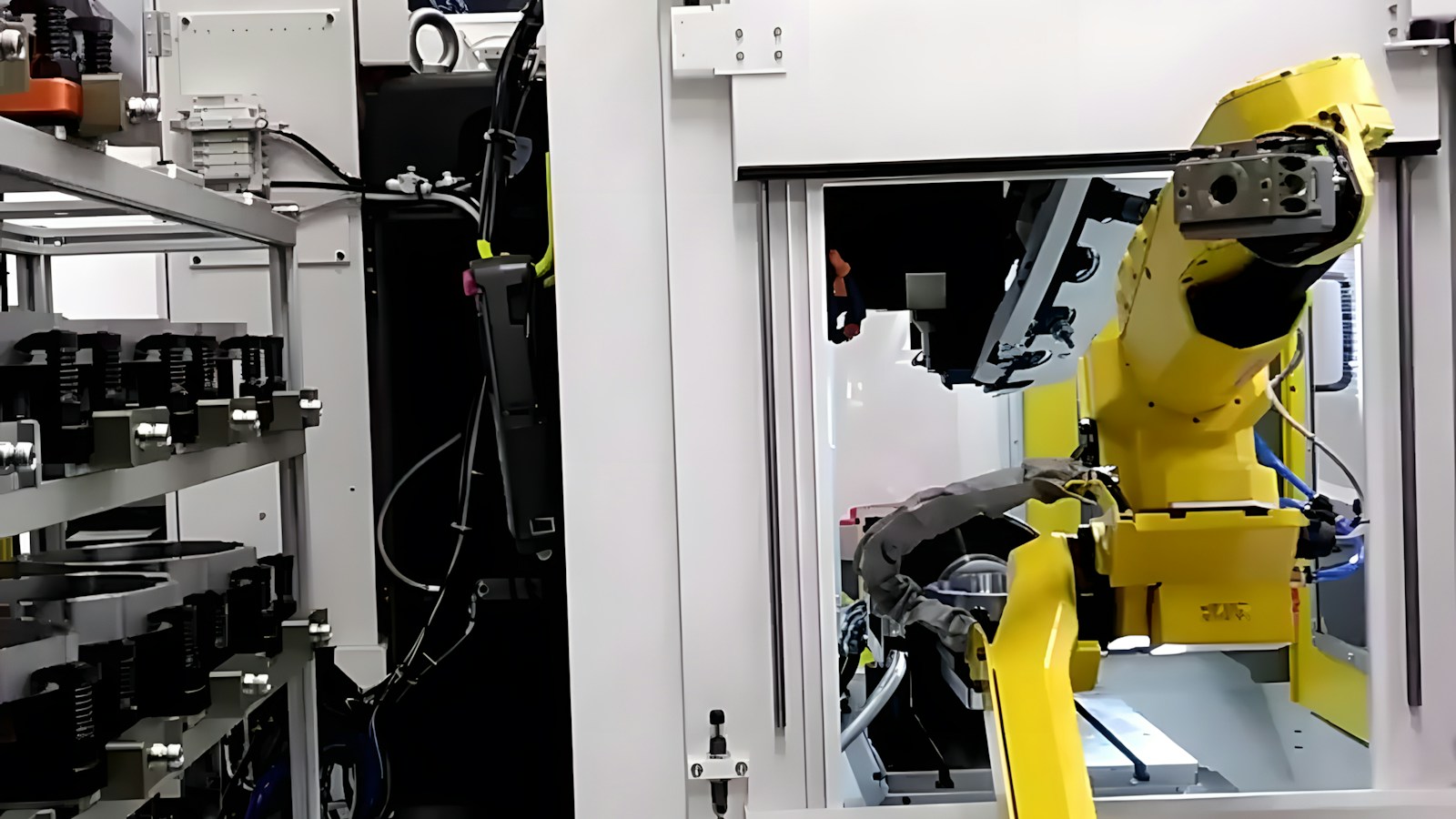
A factory robot arm. Illustrative photograph by Oso-rio / Unsplash.
Another angle on this subject
Continue through related ideas, decisions and consequences.
 The CyGuru Column
Advice Does Not Give You a Vote
A friend can use your reasoning and still reach a different decision. The adviser’s task is to improve the judgment, not collect authority.
 The CyGuru Column
Write Down the Ordinary Routines You Share
Ask an older relative to show you an everyday task while you can still do it together. The part that matters may be the detail they have never needed to explain.
 Technology & AI
AWS Emulator Moves API Tests to the Laptop. Which Tests Stay in the Cloud?
The new AWS tool reproduces parts of the cloud API on a local machine. Its fidelity reports help teams decide where cloud-based checks are still needed.