
IBM’s Nighthawk Roadmap Puts the Quantum Workflow on Trial
IBM reported faster sampling and outlined a 2027 expansion. The practical test is how long a comparable answer takes once the classical work is counted.
Inside this article
01Three figures with different jobs ↓02A sample is one draw ↓03Read the width and the operation count separately ↓Event / source date: 11 November 2026 — IBM Nighthawk performance and roadmap announcement · Published 12 NOVEMBER 2026
Three figures with different jobs
IBM’s November 11 update on its Nighthawk quantum processor contains figures about a system it has tested, a processor it is developing and an installation it intends to make in 2027. Put those milestones on separate lines. A buyer who treats a measured sampling rate, a design target and a deployment plan as one benchmark will struggle to decide what to evaluate today.
IBM reports that Nighthawk r2 achieved up to 100,000 samples per second and describes computations with more than 7,500 operations on 120 qubits. It says the next version, r3, is designed for 10,000 operations across 520 programmable qubits. The company puts the r3 physical-qubit count at 2,034 and plans to connect two r3 processors for 1,040 programmable qubits in 2027. Those last figures are company plans and design specifications. Each milestone still needs a published workload and an account of the result a researcher could actually reproduce.
A sample is one draw
When a circuit is run and measured, it yields a sample. A scientist may run it many times to estimate probabilities or observables. Faster sampling can shorten that step and let the team gather evidence across more circuit variants during a fixed allocation. The usefulness of those samples depends on how noisy they are, whether they represent the desired computation well enough, and how much work is needed to turn them into an estimate. Report a target error and an uncertainty interval alongside a count of draws.
Take a hypothetical job that uses two million samples. A sustained rate of 100,000 samples per second would put the sample-collection portion at 20 seconds if all those runs could use that rate. The clock for the project might also include mapping the algorithm to the hardware, queue time, calibration, repeating runs, moving data and running classical post-processing. A result whose uncertainty misses the requested tolerance may need to be discarded or repeated. An honest comparison preserves the raw sampling figure and records the full elapsed time, including the paths that returned unusable output.
Read the width and the operation count separately
A physical qubit is a hardware resource. IBM’s programmable-qubit figure describes what a user can address in the system it is discussing. A logical qubit is an encoded unit whose behaviour depends on an error-correction design and its demonstrated performance. A count presented in one of those categories cannot automatically be carried into the others. Researchers should state which kind they mean, what was allocated and what the available operations actually did.
Total circuit operations and circuit depth describe different properties. Independent operations can sometimes run in parallel. When later operations depend on earlier ones, the schedule lengthens. Routing operations may also be needed to bring information between qubits on a chip or across modules. Two circuits with the same count can behave very differently, especially if one involves operations that repeatedly cross boundaries. To make a 10,000-operation target useful to a reader, publish the gate mix, connectivity, schedule and acceptance criterion for the outcome. The workload can then be compared on later generations without losing the terms of the test.
Modularity earns its place in a real workload
IBM says the plan to reach 1,040 programmable qubits involves linking two r3 processors. A connection adds capacity while giving experiment designers a new feature to characterize. A workload that runs largely within each module may put very different pressure on that link from one that repeatedly exchanges information across it. To understand scaling, compare a mostly local case and a cross-module case while holding the target output quality steady. Measure the number of samples discarded, extra work done by the classical side and the elapsed time for both.
The company’s account includes workloads run with partners and improvements relative to earlier IBM hardware. Those comparisons can establish a useful engineering direction. The question of advantage against a classical approach requires its own test with a strong classical comparator, equivalent accuracy and a workload chosen for practical significance. Procurement teams can make those comparisons separately in their own scorecard. An improvement from one hardware generation to the next can justify research access even where a classical method remains the most economical way to finish the job.
Put the complete hybrid run on one clock
The workflow IBM describes brings quantum hardware into a broader classical computing environment. Researchers can ask for the full trace of a job, starting when the input is submitted and ending when an output passes an agreed accuracy test. Record preparation, waiting, hardware use, data transfer, classical compute and retries. Publish run-to-run variance and whether the method depends on selecting a favorable calibration window. Where benchmark inputs are small enough, check the answers with an independent exact method and show how the comparison changes with harder inputs.
CYPAPER’s coverage of post-quantum migration addresses a different operational decision, which is identifying where systems depend on cryptography today. A processor roadmap cannot substitute for that inventory or set a date for cryptographic compromise. The useful 2027 question is more concrete. Can two linked modules let researchers complete a worthwhile workload at a measured accuracy and cost, with both the quantum and classical work counted? Sampling speed gives IBM a credible metric to report now. The full workflow will determine where it changes a decision.
Gabriel Nicolaev — CyGuru
Sources & further reading
IBM Nighthawk performance and roadmap release ↗
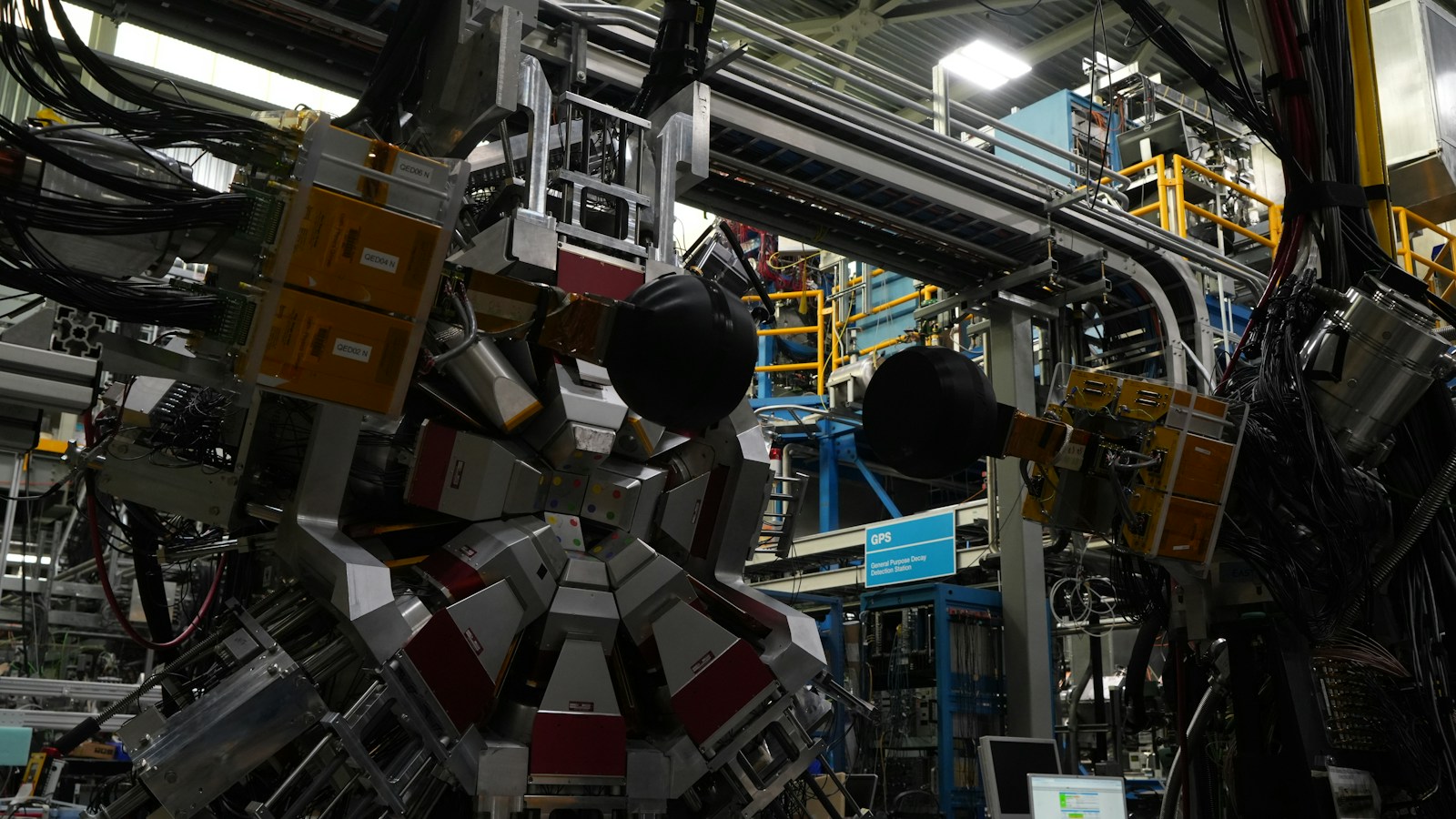
Experimental physics equipment in Vancouver. Illustrative photograph by Daniel Miksha / Unsplash.
Another angle on this subject
Continue through related ideas, decisions and consequences.
 World & Power
The G7’s Undersea Cable Pledge Puts Port Access in Focus
The Paris declaration calls for cooperation on repair ships, permits and spares. The practical test is how quickly authorities can put a prepared crew to work.
 Technology & AI
Post-Quantum Migration Starts With Knowing Where Cryptography Is Hiding
NIST’s October transition roadmap makes cryptographic discovery a practical planning task, without requiring a prediction of when a powerful quantum computer arrives.
 World & Power
The Gambia’s Peace Accord Faces Its Test When a Campaign Complaint Arrives
A renewed campaign pledge puts peaceful participation in writing ahead of the December presidential election. Its practical value depends on who handles disputes as they arise.