
Displaced Communities Need a Place in Climate Planning
UNHCR’s November warning raises an inclusion test: adaptation planning must account for people whose lives do not fit a settled-resident model.
Inside this article
01Exposure is not the same as an individual forecast ↓02A map of territory needs an account of access ↓03Temporary status should not make responsibility disappear ↓Event / source date: UNHCR presentation at the UN Geneva briefing, 6 November 2026. · Published 8 NOVEMBER 2026
Exposure is not the same as an individual forecast
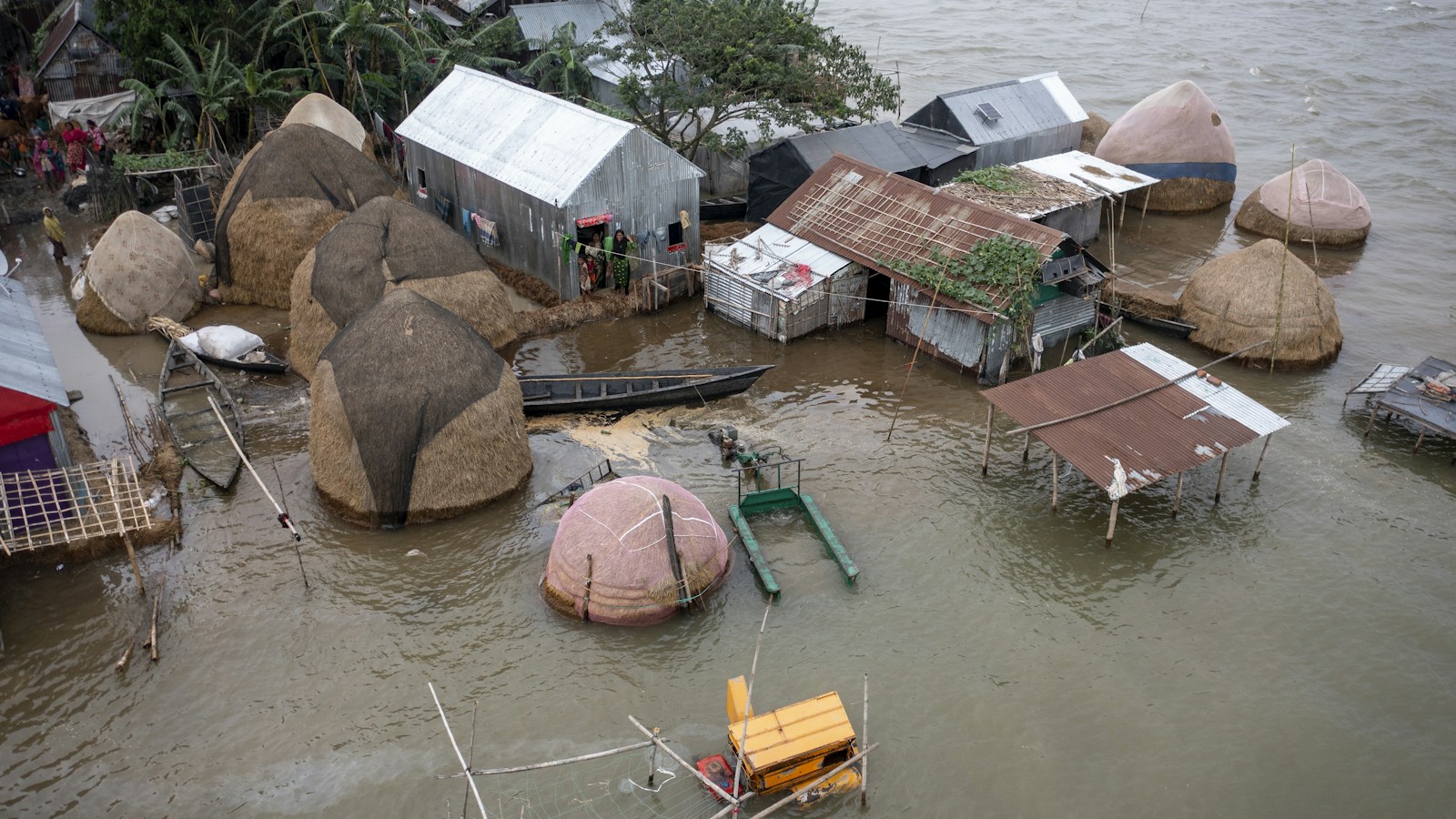
At the UN Geneva briefing on 6 November, UNHCR described a new report estimating that nearly 90 million forcibly displaced people live in countries with high or extreme exposure to climate-related hazards. This is an attributed country-exposure finding. It does not mean that every person counted will experience the same event, at the same severity, or on a specified date.
The practical question examined here is how planning includes people whose housing, documentation and access to services may change during displacement. A climate programme designed around a stable address and an established household record should explain how someone outside that model can participate. Otherwise, a plan can describe the right place while failing to recognise some of the people living there.
A map of territory needs an account of access
A municipal plan can identify a flood-prone area without showing who is able to use the proposed protection. A warning sent to registered property owners, for example, may not reach every tenant, temporary resident or newly arrived household. The hazard boundary and the service boundary are different things. Planning should make both visible.
Consider a hypothetical district improving its heat response. Listing public cooling spaces is a useful first step. The next questions concern opening hours, transport, language, admission conditions and whether people understand that they may enter. These are proposed design questions, not findings about a particular refugee settlement. They turn geographical inclusion into a test of a usable service.
Location information also needs an appropriate audience. A planning team may need enough detail to identify an access barrier without publishing a household’s precise whereabouts. A public map and a protected service record have different purposes. Inclusion should not require a displaced person to surrender unnecessary privacy merely to become visible to the programme.
Temporary status should not make responsibility disappear
Institutions can disagree over which body should serve someone whose residence is described as temporary. The person still needs an intelligible route to help. A programme should therefore identify the responsible provider and the arrangement for resolving uncertainty between organisations, rather than make the household carry that disagreement from one office to another.
This does not require every provider to perform every role. It requires a defined handover that the person can follow. If the initial office cannot act, it should know where the request goes and what information is necessary. A referral should preserve the relevant context where consent and safeguards permit, rather than require the person to reconstruct the entire account repeatedly.
Include hosts without constructing a competition for legitimacy
A response directed towards displaced people should also understand the shared systems on which host communities rely. A drainage route, a clinic access road or a shaded public space may serve several populations. Describing the project solely through one beneficiary label can obscure those relationships and make its operating responsibilities harder to explain.
In a hypothetical neighbourhood project, the useful account would identify the service being improved, its users and the burdens created during implementation. It would also explain how priorities were chosen. The purpose is not to deny differences in need. It is to avoid making access depend on a contest over who can tell the most compelling story of belonging.
Participation needs influence over the design
Inviting community representatives to a meeting is a beginning. The more demanding question is which design choices remain open to their influence. They might identify an unsuitable location, a dangerous travel route or an admission rule that defeats the project’s purpose. A responsible planning record should show how such information changed the proposal or why a different decision was made.
No representative can be assumed to speak for every person in a changing population. Planners should explain how they sought different experiences and what gaps remain. That discipline strengthens participation without pretending that a single consultation completes it. The result should be a more accurate design, not merely evidence that a meeting occurred.
Continuity should survive movement
A household may move while an adaptation programme is being delivered. A design that ties every entitlement to one address should consider what happens to information, referrals and unfinished support when that address changes. The answer will depend on the programme and local responsibilities, but it should not be an accidental discovery during implementation.
A hypothetical service could distinguish support attached to a physical asset from support attached to a person. Protecting a building and maintaining a household’s access are related obligations, not identical ones. Making the distinction explicit allows a provider to explain what continues, what changes and which organisation becomes responsible after a move.
Judge inclusion through the ordinary encounter
UNHCR’s warning gives a timely reason to examine whose circumstances climate planning assumes. The source describes heightened exposure and argues for greater inclusion. It does not establish that any particular project has solved the practical barriers discussed here. Those would need to be checked through implementation and the experience of the people using the service.
The strongest inclusion test is ordinary rather than ceremonial: can someone understand the offer, establish their position without an impossible burden, reach the service and obtain a clear answer? A plan that can meet that test has begun to connect a map of risk with a usable public arrangement. Displaced people should be part of that arrangement’s design, not an exception considered after it is complete.
Gabriel Nicolaev — CyGuru
Sources & further reading
UN Geneva: UNHCR climate-risk briefing, 6 November 2026 ↗
Editorial photograph for illustration.
Another angle on this subject
Continue through related ideas, decisions and consequences.
 World & Power
Sudan’s Shelter Warning Is Also a Stock Replenishment Warning
The UN’s 6 November briefing describes dwindling shelter supplies in Sudan. The operational test is whether funding can become usable stock before the next need.
 World & Power
Adaptation Finance Must Be Usable Before It Can Be Counted as Protection
UNEP’s 4 November update puts adaptation funding back on the agenda. The real test is when money becomes usable, by whom and for which risks.
 World & Power
US Midterms: Why Businesses Need Policy Scenarios, Not Election Certainty
Ahead of the 3 November vote, the relevant commercial question is how political outcomes might change decisions, oversight and expectations.