
Vanguard’s £12 Billion Offshore Wind Plan Reaches Financial Close
RWE and KKR have secured funding for two North Sea wind farms. Their financing and power contracts leave the owners with a multi-year delivery test.
Inside this article
01Financial close gives the project a construction budget it can call on ↓02Three numbers describe different parts of the financing ↓03The power contract addresses the price of eligible output ↓Event / source date: 11 November 2026 — RWE announced financial close for Vanguard West and Vanguard East. · Published 12 NOVEMBER 2026
Financial close gives the project a construction budget it can call on
RWE announced on 11 November that it had reached financial close with KKR on Vanguard West and Vanguard East, two offshore wind projects in the British North Sea. KKR acquired a 50% stake in each project. RWE put investment in the wind farms and their associated transmission assets at about £12 billion. It expects offshore construction to begin in early 2027 and both sites to be fully commissioned in 2030.
Financial close is a concrete advance for projects that have to commit money to factories, vessels and grid works years before electricity sales begin. The announcement establishes that the owners have assembled a financing package. The construction timetable remains RWE's expectation. What matters between those points is whether suppliers and contractors can turn the owners' financing commitments into equipment installed and tested in the right order.
Three numbers describe different parts of the financing
RWE reported £11.1 billion of cash facilities and £1.7 billion of ancillary facilities. RWE said a consortium of 35 international banks provided the project financing. It separately identified a £1 billion commitment from the UK's National Wealth Fund within that package. RWE also identified export credit cover from Euler Hermes and Denmark's Export and Investment Fund, EIFO.
The estimated investment describes the scope of spending across the projects and associated transmission. The cash facilities describe borrowing capacity. Ancillary facilities belong to a separate category of financing support. Adding the two facility figures and calling the result the cost of the wind farms would misstate what RWE announced. The size of a cash facility also tells readers little about how much has been drawn on any particular day. For a construction project, the timing matters. Money available against agreed conditions over several years has a different purpose from cash paid upfront to a supplier.
The breadth of the lender group shows how widely the financing was placed. The announcement provides limited visibility into the division of risk among those lenders. Public credit cover, for example, describes one part of the financing structure. The terms of that cover and the exposures of the parties determine its practical effect. A reader can establish the scale and participants from the release while leaving margins, fees and individual lender exposure open.
The power contract addresses the price of eligible output
The government's seventh Contracts for Difference allocation table lists Vanguard West and Vanguard East at £91.20 per megawatt-hour in 2024 prices. RWE describes the projects' contracts as inflation-indexed and running for 20 years. Britain's National Energy System Operator explains the two-way mechanism. A generator sells power into the market and the settlement compares a market reference price with the agreed strike price. The difference is paid to the generator when the reference is below the strike and goes the other way when the reference is above it.
That arrangement gives financiers a clearer basis for estimating revenue from eligible production. They still have to form a view about how much electricity the projects can deliver and when. RWE's combined 2.8 gigawatts is rated power capacity. One hour at that combined rating would amount to 2.8 gigawatt-hours of energy. Actual output over months and years depends on conditions including wind and equipment availability. The price in the auction table and the capacity figure therefore answer separate questions. Neither is sufficient to infer annual production, net project income or the change in a household bill.
The same distinction applies to construction costs. The financing uses assumptions about future installation and operation. The price contract is a tool for managing the electricity price exposure. Costs can still change if a component is delivered late, commissioning takes longer than planned or a vessel has to be scheduled again. Which party bears such costs depends on the contracts for the work.
Offshore installation and grid readiness have to meet
A foundation, an installed turbine and a completed export connection each represent a different stage of work. Electricity from a finished turbine needs a working route to the onshore network. The transmission assets inside RWE's investment estimate therefore matter to the project's ability to start generating revenue. A delay on either side can reduce the immediate value of progress on the other.
Consider a hypothetical installation window in which foundations are ready but a cable package slips. Management may be able to resequence turbine work or change how contractors use the time. The availability and cost of doing so depend on vessel contracts, component storage and weather windows. The link between a construction schedule and a contractor's cash position is already visible in CYPAPER's coverage of when construction work gets paid. Offshore projects add a coordination problem across vessels, manufacturers and the transmission connection.
The evidence after financial close will come in stages
Watch for evidence at a finer scale than the announced 2030 completion date. Offshore work beginning, transmission equipment installed and the first delivery of electricity would each answer a different question about execution. Full commissioning would answer another. Project updates that put dates on these steps will make it easier to tell a local delay from one that moves the planned opening of the whole development.
The Vanguard announcement offers a concrete example of how Britain is financing large offshore wind capacity under its price-support framework. The owners have completed a funding milestone with a specified mix of capital providers and instruments. From here the way to judge the project is to follow how that funding is converted into a connected set of assets that can sell power.
Gabriel Nicolaev — CyGuru
Sources & further reading
RWE announces Vanguard West and East financial close ↗
UK Contracts for Difference Allocation Round 7 results ↗
National Energy System Operator guide to Contracts for Difference ↗
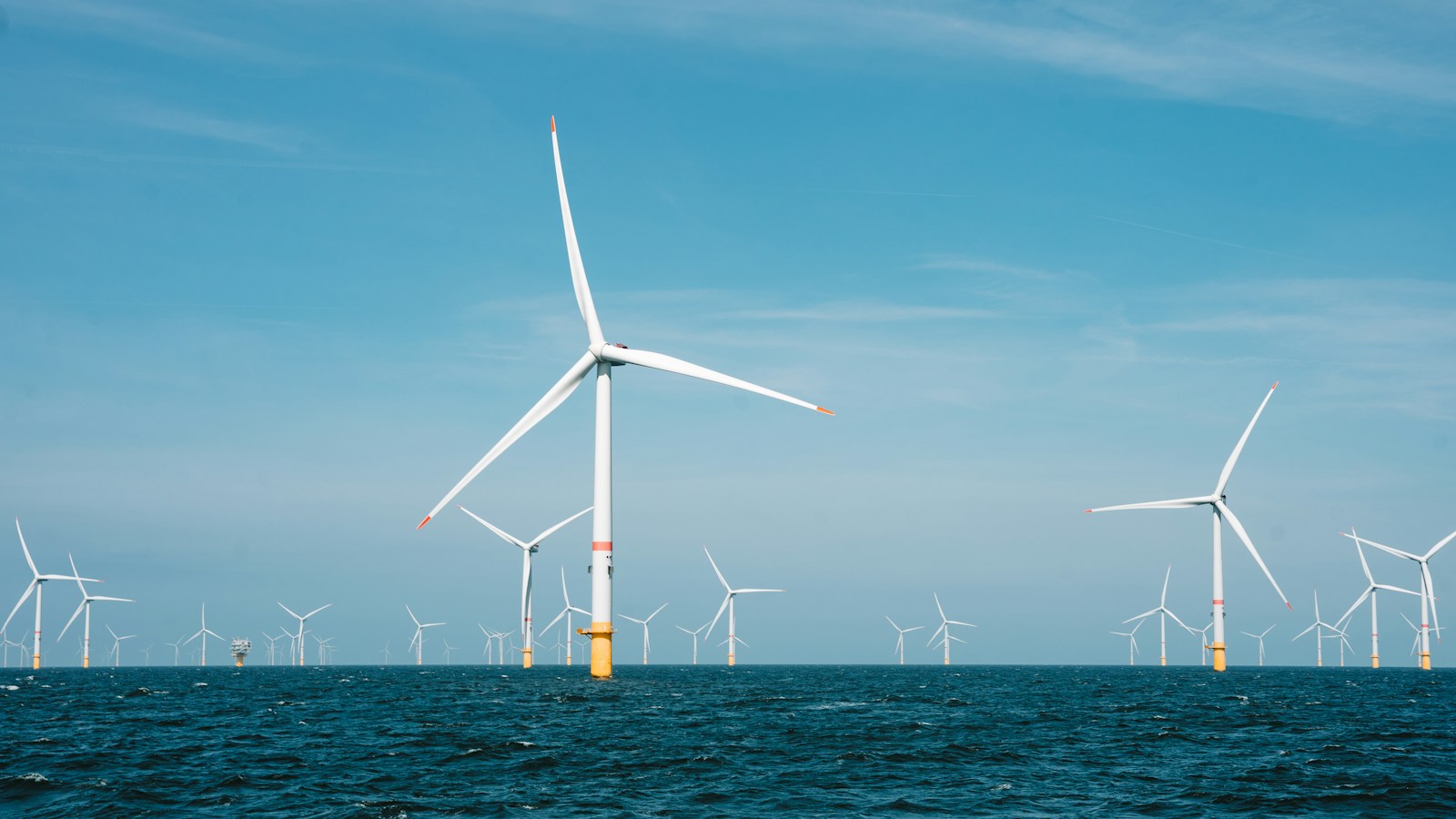
Offshore turbines in the Belgian North Sea. Illustrative photograph by Jesse De Meulenaere / Unsplash.
Another angle on this subject
Continue through related ideas, decisions and consequences.
 World & Power
Haiti’s Recovery Compact Needs Evidence the Public Can Inspect
Haiti and its partners have a one-year reform framework. How progress is documented will shape public scrutiny and decisions about future financing.
 Money & Business
Northview’s FFO Growth Has Two Engines: Properties and Financing
The REIT’s latest results put rent, occupancy and interest savings in the same headline. Each needs its own comparison.
 Money & Business
Komatsu’s Roadtec Deal Faces a Test at the Parts Counter
Komatsu has agreed to acquire two paving equipment brands from Astec. For an operator with a working fleet, the value of the handover will show up in parts, repairs and the people who know the machines.